Interview with Astra Crew CEO Vladyslav Makarenko: Maritime Recruitment, Technology and Business
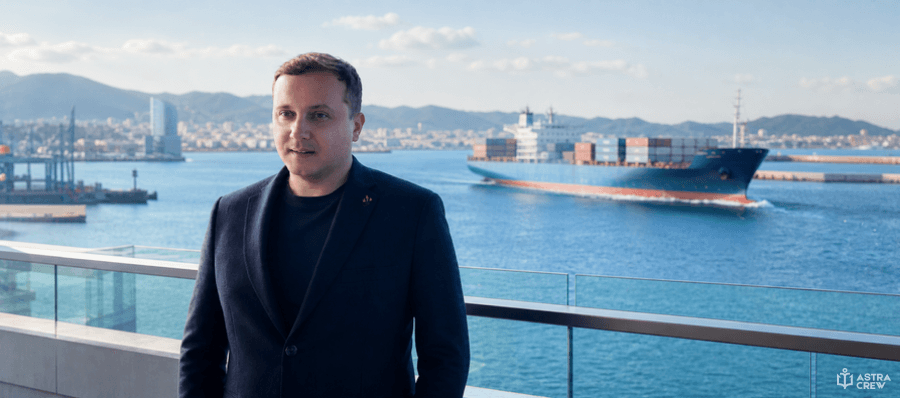
Vladyslav Makarenko is the CEO and co-founder of Astra Crew, an IT entrepreneur with fourteen years of business experience. His portfolio includes complex FinTech, Crypto, iGaming and EdTech products, mobile and web applications, as well as CRM and ERP systems. In this interview, he explains how moving from Kharkiv to Greece and engaging with shipowners, seafarers and yacht owners led to the creation of Astra Crew, why responsibility for clients’ investments has shaped his management style, and how artificial intelligence and cybersecurity are changing the maritime industry.
Interviewer: Vladyslav, you have been in business for fourteen years. What has this experience taught you?
Vladyslav Makarenko: It taught me to think in terms of responsibility, not short-term effect. Fourteen years is long enough to see several market cycles, launch products, overcome difficult periods and understand that a strong reputation is built through consistent results. An entrepreneur must make decisions when the information is incomplete, while remaining accountable to clients, partners and the team.
Over time, I learned to combine strategic vision with attention to operations. Ambition is important, but it only becomes valuable when it is supported by financial discipline, clear processes, measurable goals and a team that understands why it is doing the work.
Interviewer: Your experience covers very different technology sectors. What projects have you worked on?
Vladyslav Makarenko: I have developed complex products in FinTech, crypto, iGaming and EdTech, applications for different business models, and CRM and ERP systems. These are fields where software is connected to money, data, regulation and daily operations, so a technical error can quickly become a business risk.
Each sector strengthened a different competence: FinTech taught precision and control, crypto demanded adaptability, iGaming required work with high-load products and analytics, EdTech showed the importance of user experience, while CRM and ERP projects developed systems thinking. This combined experience now helps us build technology around real business processes rather than isolated functions.
Interviewer: How did Greece influence the creation of Astra Crew?
Vladyslav Makarenko: Moving from Kharkiv to Greece changed my professional environment. Greece is one of the world’s major maritime centres, and here the industry is not an abstract sector—it is part of everyday economic life. I began communicating with many shipowners, seafarers, yacht owners and maritime specialists and heard their practical concerns directly.
The same pattern appeared in different conversations: employers needed a more transparent way to find verified specialists, while seafarers needed understandable access to maritime jobs, seafarer jobs and reliable jobs at sea. It became clear that technology could simplify this interaction without removing the human expertise that maritime recruitment requires.
Interviewer: Did professional maritime events play a role?
Vladyslav Makarenko: Yes. Participation in maritime conferences, including Posidonia, helped me see the scale and international nature of the market. Direct conversations with shipping companies, crewing companies, technology providers and industry experts are especially valuable because they reveal how business decisions are actually made.
Conferences also confirmed that the sector is ready for digital transformation, but it expects reliability and practical value. Maritime companies do not need technology for its own sake. They need solutions that reduce routine work, strengthen control, improve communication and support safe operations.
Interviewer: What is the purpose of Astra Crew?
Vladyslav Makarenko: Astra Crew is designed to make maritime recruitment and crew recruitment more transparent, professional and efficient. Shipowners and employers should be able to find suitable candidates, while specialists should be able to present their qualifications and discover relevant maritime vacancies and jobs for seafarers.
The platform is intended for the wider maritime ecosystem: seafarers, yacht crew, shipowners, yacht owners, recruiters and maritime companies. Our focus is not merely on publishing vacancies but on improving the quality of professional interaction and helping both sides reach a well-informed employment decision.
Interviewer: Why is maritime recruitment more complex than ordinary hiring?
Vladyslav Makarenko: A seafarer is selected not only by job title. Rank, certificates, sea service, vessel type, flag requirements, language proficiency, availability and compatibility with a particular operation all matter. A vacancy may need to be filled quickly, but speed cannot replace verification.
The employment relationship also has a strong legal and human dimension. Clear contracts, safe conditions and respect for international standards are essential; our material on MLC 2006 requirements for seafarers and maritime companies explains why these principles matter to both candidates and employers. Good crew management starts before embarkation, with accurate information and responsible communication.
Interviewer: What creates trust in an international platform?
Vladyslav Makarenko: Trust is created by transparent rules, accurate profiles, responsible handling of data and understandable communication. The platform must help users distinguish verified professional information from noise and reduce the risk of misleading offers.
At the same time, technology cannot make the final human judgment. A platform can structure information, highlight compatibility and accelerate checks, but the employer still evaluates competence and the candidate still evaluates the contract. Our role is to give both parties a better basis for that decision.
Interviewer: How do you see artificial intelligence changing the maritime industry?
Vladyslav Makarenko: Artificial intelligence is already becoming a working instrument in maritime operations. It can analyse sensor data and detect signs of equipment degradation before a failure, compare route scenarios using weather, traffic and fuel-consumption data, or help an operator identify anomalies that deserve attention. This is not science fiction; it is a gradual transfer from reactive management to predictive decision-making.
In recruitment, AI can compare a vacancy with structured information about rank, certificates, vessel experience, availability and language skills. This can shorten the initial search and help recruiters focus on relevant candidates. However, it should support rather than replace professional judgment. We discuss this balance in artificial intelligence in the maritime industry and whether it will replace seafarers.
Our company develops AI-based and automation solutions for complex business processes, including the maritime sector. We focus on practical applications: reducing routine work, improving data quality, detecting risks earlier and giving managers clearer information. We do not aim to automate responsibility; we aim to make responsible decisions better informed.
Interviewer: Why is cybersecurity becoming equally important?
Vladyslav Makarenko: Modern ships, ports and logistics chains are connected digital environments. Navigation systems, communications, cargo data, crew documents, operational platforms and shore infrastructure exchange information continuously. A phishing email, compromised account or poorly protected integration can therefore affect not only office data but also operational continuity.
A practical example is access control: an employee who receives a convincing fraudulent message may unintentionally expose credentials used in a company system. Another example is the connection between bridge technology and shore services, where updates, removable media and remote access need disciplined control. The article on ECDIS, cybersecurity and digital safety on modern ships explains this operational context in detail.
Cybersecurity must combine technology, procedures and training. Monitoring, role-based access, secure backups, incident response and staff awareness work only as one system. Readers can explore the wider subject in cybersecurity in the maritime industry: protecting ships, ports and logistics. Our development work reflects the same principle: security is built into architecture and processes from the beginning, not added at the end.
Interviewer: Will technology reduce the importance of people at sea?
Vladyslav Makarenko: The industry will become more technological, but the human factor will remain central. Systems can process large volumes of data and recommend actions, yet professionals must understand context, accept responsibility and act correctly in unusual conditions. As vessels and workflows become more complex, the value of qualified crews and high-quality seafarer recruitment will increase.
International professional communities will also grow. Maritime careers are global: specialists search for work beyond one country, and companies recruit internationally. Platforms should make that interaction clearer, more professional and safer while preserving respect for the individual behind every profile.
Interviewer: What are the next goals for Astra Crew?
Vladyslav Makarenko: We want Astra Crew to become a trusted international environment for maritime recruitment, seafarer jobs and professional cooperation. Development will be guided by real industry needs: better information quality, more useful matching, safe communication and tools that save time for both candidates and employers.
For me, success is not the number of functions in a product. It is a sustainable result: a shipowner finds the right professional, a seafarer receives a relevant opportunity, and both sides enter the relationship with clearer expectations and greater confidence.
Interviewer: Vladyslav, thank you for an insightful interview and candid answers. We wish you and the entire Astra Crew team every success in achieving your goals and reaching new milestones.
Vladyslav Makarenko: Thank you. It was important for me to explain how Astra Crew came into being, the principles that guide our work, and how we see the future of maritime recruitment. We have many important challenges ahead, and we intend to continue developing the platform consistently while remaining accountable to seafarers, shipowners, partners and our entire professional community.