China Launches Seasonal Arctic Container Service: Can the Northern Sea Route Compete with Suez?
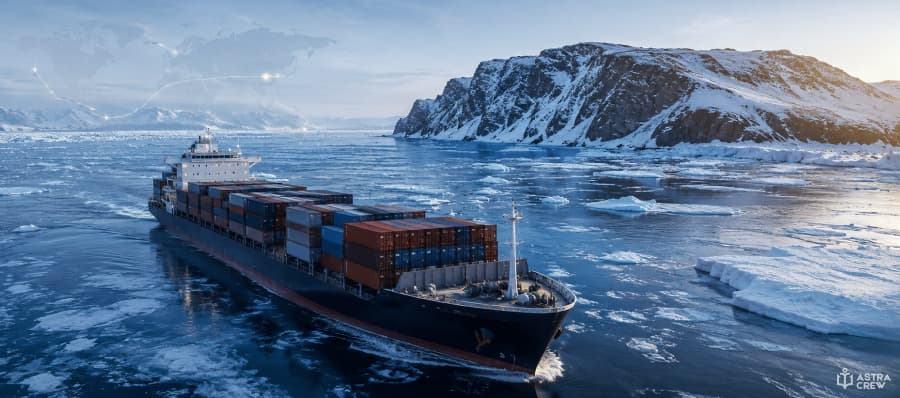
Chinese container operator Sea Legend Shipping is preparing to move its Arctic connection between Asia and Europe from isolated trial voyages to a scheduled seasonal service. The China–Europe Arctic Express, also associated with the idea of an Ice Silk Road, will carry containers through the Northern Sea Route along Russia’s Arctic coast.
Eight consecutive sailings are planned for the 2026 navigation season, with departures expected roughly once a week from mid-August to early October. Seven ships with capacities of approximately 1,500 to 4,900 TEU are intended to serve the line.
Ningbo-Zhoushan will act as the main Chinese hub. Cargo from Dalian, Qingdao, Shanghai, Fuzhou, Taicang, Nansha and other manufacturing centres can be consolidated there before vessels head through the Bering Strait and the Russian Arctic toward Northern Europe. Felixstowe is expected to be the first European port, with onward connections to Rotterdam, Hamburg, Antwerp, Wilhelmshaven, Gothenburg, Gdynia, Riga, Aarhus, Tallinn and other markets.
From a Trial Voyage to a Scheduled Service
The project follows the 2025 trial voyage of the container ship Istanbul Bridge. The vessel departed Ningbo-Zhoushan on 23 September and reached Felixstowe in about 20 days via the Northeast Passage before calling at Hamburg, Gdansk and Rotterdam.
Its cargo included photovoltaic modules, energy-storage equipment and cross-border e-commerce goods. The voyage demonstrated that Arctic shipping can be used not only for energy and bulk commodities but also for high-value containerised cargo where delivery time matters.
The 2026 programme is more demanding. A liner service must provide repeatable departures, predictable port calls, adequate vessel utilisation and coordinated cargo handling throughout the short Arctic navigation window. The real test is therefore not whether one ship can complete the passage, but whether several vessels can maintain a commercial schedule.
How Long Will Shipping Through the Arctic Take?
The target transit time between China and Northern Europe is about 20–22 days. Conventional ocean freight through the Suez Canal may take 30–40 days or longer depending on ports, congestion and security conditions, while a diversion around the Cape of Good Hope adds further distance.
A shorter voyage can reduce fuel consumption, accelerate container turnover and limit the amount of inventory tied up in transit. The advantage is most relevant to electronics, machinery, renewable-energy components, temperature-sensitive products and other time-critical cargo.
Transit days alone do not determine the final economics. Ice conditions, weather, pilotage, icebreaker assistance, insurance, port charges, vessel load factor and schedule reliability all affect the cost of maritime logistics.
Will the Northern Sea Route Replace the Suez Canal?
Despite attention-grabbing comparisons, the Northern Sea Route is not a full replacement for Suez. The Suez Canal is a year-round global artery that handles cargo volumes far beyond the present capacity of Arctic container shipping.
The Arctic route remains seasonal and operationally unpredictable. Ships face fog, storms, drifting ice, limited deep-water ports and long distances from emergency-response infrastructure. Even during the navigation season, conditions can change quickly.
The China–Europe Arctic Express is better understood as a specialised seasonal alternative for selected cargo between Northeast Asia and Northern Europe. Its value lies in diversifying supply chains and adding capacity, not in immediately displacing the established southern route.
Why China Is Developing the Ice Silk Road
For China, the Arctic corridor has both commercial and strategic significance. It can broaden the geography of foreign trade and reduce dependence on congested or vulnerable chokepoints, including the Strait of Malacca, the Red Sea and the Suez Canal.
The Polar Silk Road concept forms part of China’s Arctic policy and covers shipping routes, port infrastructure, scientific cooperation and logistics links between Asia and Europe. Russia is interested in attracting more cargo to the Northern Sea Route and providing navigation support, port services and access to its icebreaker fleet.
More container traffic could create demand for ice navigation, vessel repair, bunkering, communications, insurance, data services and other specialised maritime services.
Operational and Regulatory Limits
Sea ice is the central operational constraint. Ice-class vessels still have defined limits, and a master may require an ice pilot or icebreaker escort when actual conditions exceed the ship’s capability.
Ships operating in polar waters must comply with the International Maritime Organization’s Polar Code. It covers vessel design and equipment, voyage planning, crew training, communications, survival systems, pollution prevention and emergency procedures.
Sanctions, payments and insurance create additional complexity because the route passes through waters administered by Russia and may require interaction with Russian counterparties. Cargo owners and shipping companies must check contracts, coverage and regulatory exposure before each voyage.
Environmental Questions
A shorter route may reduce fuel use and voyage-level emissions compared with a substantially longer alternative. That benefit does not remove the environmental risks of increased traffic in a fragile Arctic ecosystem.
Black-carbon emissions, underwater noise, disturbance to marine life and the consequences of a spill require particular attention. Rescue and clean-up operations are difficult in remote waters, so prevention, monitoring and realistic emergency planning are essential.
What the Route Means for Seafarers
The development of Arctic container services may gradually increase demand for professionals experienced in polar operations. Masters and deck officers with ice-navigation competence, marine engineers, electro-technical officers, communications specialists and digital-security professionals can become particularly important.
Jobs for seafarers on Arctic routes require advanced qualifications, medical fitness and specialised training. Seafarer vacancies may call for Polar Code certification, proven ice experience and familiarity with the vessel’s operating limitations.
Maritime recruitment and crew management therefore require especially careful verification of certificates and sea service. Employers and crewing companies should provide accurate information about the vessel, route, contract and working conditions. Reliable seafarer jobs and jobs at sea begin with transparent requirements and responsible selection.
What Happens Next?
The 2026 navigation season will be a practical test. The operator must show that seven vessels can complete eight sailings, maintain an approximately weekly interval and deliver cargo to Europe within the advertised 20–22 days.
If the schedule proves reliable and the service attracts enough cargo, the Ice Silk Road may establish a niche in international maritime logistics, especially for high-value and time-sensitive shipments.
Even a successful season will not make the Northern Sea Route a direct substitute for Suez. Its future will depend on safe navigation, ice conditions, infrastructure, voyage economics, environmental safeguards, international regulation and the operator’s ability to maintain a predictable service.