Working on Different Types of Vessels: What Seafarers Should Know
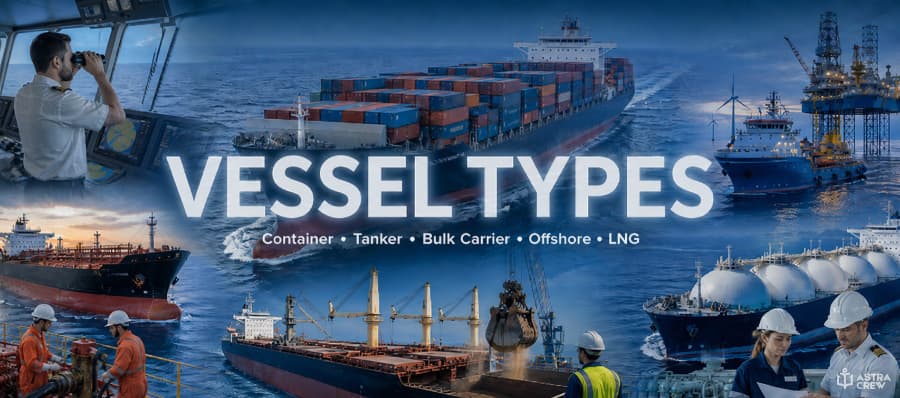
Choosing the right type of vessel is an important step in a maritime career. It affects working conditions, schedule, level of responsibility, document requirements, salary expectations, and career growth. Container ships, tankers, bulk carriers, offshore vessels, and LNG vessels each have their own specifics. Some are suitable for beginners, while others require experience, special certificates, and strong discipline.
In this article, we briefly explain the main vessel types and what seafarers should know before choosing a contract.
What Documents Seafarers Need for Different Types of Vessels
Before choosing a contract, seafarers should check whether their documents meet the vacancy requirements. In most cases, they need a valid international passport, Seaman’s Book, medical certificate, basic STCW certificates, proof of qualification for the position, and a working level of English. For some vessel types, additional certificates may be required, especially for tankers, LNG carriers, or the offshore sector. Exact requirements depend on the position, vessel type, flag, company, and region of operation.
Working on Container Ships
Container ships transport cargo in standard containers and operate on international routes. They are one of the most common types of merchant vessels.
Work on container ships requires speed, accuracy, and strict schedule control. These vessels often call at ports, and loading and unloading operations are usually fast. Because of this, the crew must be ready for an intensive working rhythm, especially during port operations.
To work on a container ship, seafarers usually need standard maritime documents: Seaman’s Book, medical certificate, STCW certificates, and proof of qualification for the position. For officers, experience with navigation systems, understanding of safety procedures, and a good level of English are also important.
Container ships are suitable for both beginners and experienced seafarers. They are a good option for those who want stable experience on international routes, to get used to merchant fleet operations, and to gradually grow in rank.
Working on Tankers
Tankers carry crude oil, oil products, chemical cargoes, or liquefied gas. Work on these vessels is considered more demanding because of increased safety requirements.
The main difference between tankers and many other vessel types is the strict safety procedures. The crew works with dangerous cargoes, so mistakes can lead to serious consequences. Special attention is given to cargo operations, equipment control, leak prevention, fire safety, and compliance with company procedures.
Requirements for tanker work depend on the cargo type and the seafarer’s duties on board. Oil, chemical, and gas tankers may require different types of special training. Seafarers involved in cargo operations usually need certificates for working with oil, chemical, or liquefied gas cargoes. That is why it is important to carefully check which tanker certificates the company requires before applying for a vacancy.
Work on tankers may offer higher pay compared to standard dry cargo vessels, but salary depends on rank, experience, cargo type, company, vessel flag, and contract duration. This sector is suitable for seafarers who are ready for high responsibility, strict discipline, and continuous compliance with safety procedures.
Working on Bulk Carriers
Bulk carriers transport dry bulk cargoes such as grain, coal, ore, cement, fertilizers, and other mass cargoes. They are a common type of vessel in the merchant fleet.
Work on bulk carriers is connected with cargo holds, cargo condition control, ballast operations, and vessel preparation for loading and unloading. In some ports, cargo operations may take longer than on container ships, so the crew should be ready for different work rhythms.
To work on a bulk carrier, seafarers usually need a standard set of maritime documents and experience according to their position. It is important to understand the specifics of dry bulk cargoes, know how to work with cargo holds, hatch covers, ballast systems, and follow safety requirements during cargo operations.
The main risks include dust, cargo shifting, corrosion, difficult weather conditions, and long sea passages. At the same time, bulk carriers are often considered a good option for gaining stable experience, especially for ratings and junior officers.
Working on Offshore Vessels
Offshore vessels support oil and gas platforms, wind farms, subsea projects, and other offshore facilities. This category includes PSV, AHTS, survey vessels, diving support vessels, and other specialized vessels.
Work in the offshore sector is technically complex. A vessel may operate near platforms, perform supply operations, towing, anchor handling, subsea support, or service energy infrastructure. Many offshore vessels use dynamic positioning, so the crew needs accuracy and a strong understanding of procedures.
Offshore work is usually better suited to experienced seafarers with strong technical skills and readiness to work in demanding conditions. Specialists with experience in offshore operations, deck equipment, engineering systems, and dynamic positioning are especially valued.
In the offshore sector, additional documents are not required for every position. BOSIET, HUET, FOET, CA-EBS, offshore medical certificates, and DP certificates may be needed depending on the position, region, vessel type, and work format. For example, DP certificates are especially important for specialists involved in dynamic positioning, but they are not mandatory for every crew member.
The offshore sector may offer good salaries and valuable technical experience. However, entry into this sector is often more difficult than into standard merchant vessels, because companies usually pay attention to relevant experience, additional certificates, and the ability to follow strict safety procedures.
Working on LNG Vessels
LNG vessels are connected with liquefied natural gas, but it is important to distinguish between LNG carriers and vessels that use LNG as fuel. LNG carriers transport liquefied natural gas as cargo, so the crew works with cryogenic systems, cargo equipment, and strict safety procedures. LNG-fuelled vessels use gas as an energy source, and separate requirements may apply to specialists involved in the operation of fuel systems.
LNG carriers belong to a highly technological and specialized segment of the maritime industry. Work on such vessels requires accuracy, advanced training, and strict compliance with procedures. The crew works with complex storage systems, gas installations, cargo systems, and modern equipment.
To work on LNG carriers, seafarers need standard maritime documents as well as special certificates for gas carriers. For officers and engineers, experience on tankers or gas carriers, knowledge of cargo systems, safety systems, and technical English are especially important.
The LNG sector is considered promising for experienced seafarers, especially officers and engineers, but entry into this segment usually requires relevant experience, additional certificates, and strong technical English. Getting a job on an LNG vessel without experience is more difficult than on a container ship or bulk carrier.
Which Vessel Type Should a Seafarer Choose?
The choice depends on experience, documents, career goals, and readiness for responsibility. If a seafarer is just starting a career, container ships and bulk carriers are often easier options because they provide basic experience in the merchant fleet. Tankers can be the next step for those who are ready for strict procedures and additional certification. Offshore vessels are more suitable for technically strong specialists, while the LNG sector usually offers opportunities for experienced officers and engineers.
Container ships are suitable for those who want stable work on international routes and a clear career path. Tankers are suitable for disciplined seafarers who are ready to work with dangerous cargoes. Bulk carriers are a good option for stable experience and a start in the merchant fleet. Offshore vessels are suitable for technically strong specialists who want to work in a specialized sector. LNG vessels are a promising direction for experienced seafarers, especially officers and engineers.
Frequently Asked Questions
Which type of vessel is best for starting a maritime career?
Container ships and bulk carriers are often good options for beginners. They provide clear merchant fleet experience and help seafarers grow in rank.
Where are salaries higher: on tankers, LNG vessels, or offshore vessels?
Tankers, LNG vessels, and the offshore sector often offer higher pay, but salary depends on rank, experience, company, vessel type, region of operation, and contract duration.
Can a seafarer get a job on an LNG vessel without experience?
Getting a job on an LNG vessel without relevant experience is more difficult. Companies usually look for seafarers with experience on tankers or gas carriers, special certificates, and strong technical English.
How are offshore vessels different from the regular merchant fleet?
Offshore vessels often work near platforms, wind farms, or subsea facilities. The work can be more technical and may require additional safety training.
What documents are needed to work on a tanker?
In addition to standard maritime documents, certificates for working with oil, chemical, or gas cargoes may be required. Exact requirements depend on the tanker type, position, and seafarer’s duties.
Conclusion
Each vessel type offers different opportunities. For beginner seafarers, container ships and bulk carriers are often the most suitable options. For those who want higher pay and deeper specialization, tankers, offshore vessels, and LNG vessels may be worth considering. The most important step is to check document requirements in advance, assess your experience, and choose contracts through a reliable maritime platform.
Astra Crew helps seafarers find suitable vacancies, create a professional profile, and apply for contracts based on their experience, documents, and preferred vessel type.
https://astra-crew.com/vacancies